
A Lecture on Ottoman Heritage in Serbia

On June 20, within the framework of cooperation with the Faculty of Philology of the University of Belgrade, Slovo hosted a lecture on the Ottoman presence in Serbia – its traces in stone, sound, and customs. The lecturer was Ana Asani, a philologist and teacher of Turkish language and literature, as well as a master’s student at the Faculty of Philology in Belgrade. Ana is completing the practical part of her master’s studies at our Serbian language center.
Five centuries of Ottoman rule – from the fall of Smederevo in 1459 to the Congress of Berlin in 1878 – left behind a legacy that is not always immediately visible. Many things that seem traditionally Serbian today actually came from the East and have long since become part of everyday culture.
A Battle That Became an Epic
Before speaking about architecture and everyday life, Ana Asani turned to where the story began – to the Battle of Kosovo on June 28, 1389. This battle between the Serbian and Ottoman armies on Kosovo Field became much more than a historical event. It transformed into the foundation of an entire layer of Serbian folk culture – the Kosovo Cycle of Epic Poetry (Kosovski ciklus). These songs are considered among the strongest works of Serbian oral epic tradition. They are all connected by the same heroes and cover a short period of time: before, during, and after the battle. The Battle of Kosovo remains a living point of Serbian identity today. It is commemorated every year on Vidovdan, June 28.

The City as a Reflection of an Era

Ana continued the lecture with a story about the structure of the Ottoman city.
The conquerors did not destroy what they found – they adapted it. The city was divided into three main parts: fortress (kale), commercial center (čaršija) and residential quarters (mahale). This structure shaped Belgrade, Niš, Novi Pazar, Prizren, Sarajevo, and almost all major Balkan cities.

A mahala was not simply a neighborhood – it was a small community. It developed around a mosque or a water source, with narrow winding streets and high walls protecting private life. The čaršija was the economic heart of the city, where craftsmen organized into guilds (esnafi), and covered markets (bezistans) sold silk, jewelry, and other goods. This principle can still be seen today in the old quarters of Sarajevo and Prizren.
The House Turned Inward
Ana Asani also spoke separately about the traditional Eastern-style house. Its main idea was peace and privacy. The house did not open directly onto the street. It was protected by high walls or fences, and the courtyard served as a transition between the outside world and the private inner space. The house usually had two floors. The lower, stone floor was functional: kitchen, storage areas, and few windows. The upper floor was the center of everyday life. It was wider than the lower one, extended outward, and had many windows. In the middle of the upper floor was the sofa, or divanhana – the main shared room from which other rooms could be accessed.
This tradition did not disappear completely. In the second half of the 19th century, Serbia began turning toward Western architectural models, and older buildings gradually disappeared. However, several examples of Eastern-style houses survived. In Belgrade, these include: Konak of Princess Ljubica (Konak kneginje Ljubice), Manak’s House (Manakova kuća) and Dositej’s Lyceum (Licej Dositeja). They remain living witnesses of that era and can still be seen today.
The Stones That Remained

Most mosques (džamije) were destroyed during the 18th and 19th centuries, after the liberation of Serbia. In the 17th century, the traveler Evliya Çelebi counted more than 270 mosques in Belgrade. Today, only one remains: Bajrakli Mosque (1575–1577). It received its name because a flag (barjak) was raised from its minaret to signal prayer times to the other mosques in the city.
Some hammams also survived. The Isa Bey Hammam in Novi Pazar is one of the oldest on the Balkans west of Istanbul. It was built in the 15th century by the founder of the city. Hammams were not simply bathhouses. They were places for socializing, gathering, and ritual purification before prayer. The Prince Miloš Hammam in Belgrade (1838) survived even though the palace next to it was destroyed during the 1941 bombing.
A Person Within the System
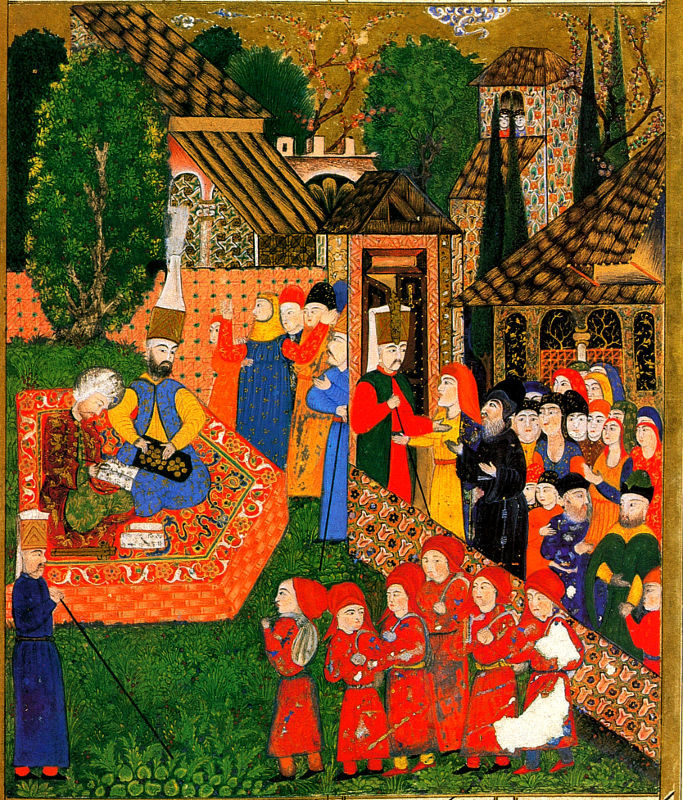
One of the most fascinating parts of the lecture was the system of devşirme, known as the “blood tax” (danak u krvi). The Ottoman Empire periodically took boys from Christian families, converted them to Islam, taught them Turkish, and prepared them for state service. The most talented were sent to Enderun – the palace school in Istanbul – from which many future viziers, admirals, and diplomats emerged.
The most famous example of this path is Mehmed Pasha Sokolović. Born in Bosnia as Bajica Nenadić, he became Grand Vizier under three Ottoman sultans. The bridge in Višegrad, commissioned by him and built by the architect Mimar Sinan between 1571 and 1577, is now a UNESCO World Heritage Site.
What Became Our Own

Many elements that are now considered part of traditional Serbian clothing actually have Eastern origins. For example: jelek – a short sleeveless vest, čakšire – wide traditional trousers and anterija – a long robe with wide sleeves. Musical instruments such as: zurla – a wind instrument and tapan – a large drum, which are still essential parts of weddings in southern Serbia, also arrived through Ottoman influence. The word mahala itself came from Arabic through Turkish. There are hundreds of such borrowings – Turcisms – in the Serbian language, and many remain alive today.
The lecture ended with a discussion of literature. Ivo Andrić, Meša Selimović, and Bora Stanković each explored this heritage in their own way. Andrić wrote about architecture and destiny (kismet). Selimović explored Islamic mysticism and Ottoman law. Stanković wrote about emotions (sevdah), music, and Eastern interiors. Ana Asani ended the meeting with a quote from Ivo Andrić:
Life is an incomprehensible miracle: it constantly wears away and disappears, and yet it continues and stands firmly, like the bridge over the Drina.
Meetings like this change the way you see a city. You leave the lecture and walk outside – and Belgrade feels slightly different. You notice the curve of an old street, the silhouette of a minaret, an ornament on a building facade – and now you know where it came from. For those of us who came to Serbia from another country, lectures like this are more than education. They are a way of entering the history of the place that welcomed us. A way to understand it not only through language, but also through stone, music, and the organization of its spaces.
Thank you to Ana Asani for this lecture – and for sharing her knowledge so generously and warmly.
Elena Titova Student at Slovo


Comments