
Education in Serbia: A Simple Guide for International Families
Updated: Dec 5, 2025
Dobar dan! :)
If you’re an international family living in Serbia — or planning to move here — understanding the education system can make your transition much easier. Many of our learners at our Serbian language school ask how schools work, what options exist, and how to prepare their children for enrolment.
Pre-school
Serbia offers several stages of early childhood education:
Jaslice — For children aged 6 months to 3 years. This is similar to daycare or nursery in many countries.
Vrtić (Kindergarten) — For ages 3 to 5.5, focused on play, language development, and early learning.
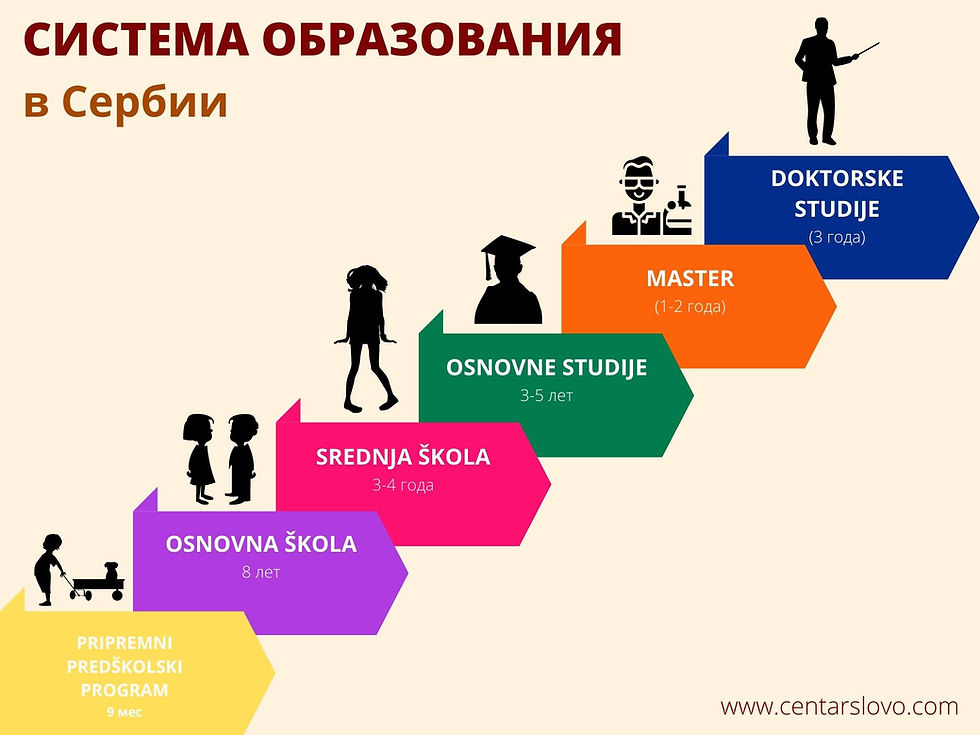
Pripremni predškolski program — A mandatory pre-school preparation program for children aged 5.5 to 6.5.
It lasts nine months, and children receive a certificate upon completion.
This certificate is usually required for primary school enrollment, though many schools show flexibility with newly arrived international families.
Primary school
Osnovna škola lasts eight years, and primary education is compulsory at the national level.
In grades 1–4, one main teacher works with the class.
In grades 5–8, children have different teachers for separate subjects.
How students address teachers
Serbia does not use middle names or patronymics. Students simply use the polite forms “učitelju” (teacher) or “nastavniče” (subject teacher).
Final exam at the end of primary school
The završni ispit (final exam) includes:
Serbian language
Mathematics
A combined test (science + social studies)
These results, together with points earned during schooling, determine placement in secondary school.
Middle school
Srednja škola lasts 3 or 4 years, depending on the type of school.
There are two pathways:
1. Vocational schools
These prepare students for specific professions and practical skills (economics, IT, hospitality, construction, arts, design, and more).
2. Gimnazija (General Gymnasium)
A 4-year academic program offering a broad education in humanities or sciences.Most graduates continue to university.
Teachers in secondary schools are called “profesor/profesorka.”
University
Fakultet is a higher education institution with significant autonomy. Each faculty sets many of its own internal rules.
Since 2005, Serbia has followed the European Bologna system, which includes:
60 ECTS credits per year
240 credits for a bachelor’s degree (usually 4 years)
3-year and 5-year programs for certain fields
Master’s programs
Typically 1 year,
or 2 years if the bachelor’s program lasted only 3 years.
Doctoral studies (PhD)
After completing a master’s degree, students may continue directly to a PhD program.
Serbian universities actively participate in European academic networks, including the well-known Erasmus+ exchange program.
Considering a move to Serbia? Learning Serbian helps a lot.
International families often choose to take Serbian language courses to adapt faster:
easier communication with teachers and schools
smoother everyday life and paperwork
stronger connection with the local community
better support for children entering Serbian schools
At our Serbian language school, we help learners from all over the world feel confident, welcomed, and supported during their transition to life in Serbia.
Have more questions? We’re happy to help.
If you need guidance on the school system, enrollment, documents, or want to learn Serbian in a friendly and effective way, feel free to contact us.
Wishing all families a joyful and successful school year! 🎒✨
Author: Dijana Karanović
This text was prepared by the teaching team of the Serbian Language Center Slȍvo.
Learn more about us and our programs: centarslovo.rs.
Comments