
Palace of Serbia: Nine Tons of Crystal and the Spirit of Yugoslav Modernism
- Aug 12
- 4 min read
Palace of Serbia: What Lies Behind New Belgrade’s Most Mysterious Facade
On the last day of April, our students had the opportunity to step inside the Palace of Serbia, one of the most iconic monuments of Yugoslav modernist architecture. Far more than a government building, it is a remarkable time capsule of mid-twentieth-century design. Our tour began in the vast central hall, where the sheer scale of the building immediately conveys its historical significance. It was here that the foundations of the Non-Aligned Movement were laid.

A Brief History
Located in New Belgrade, between Mihajlo Pupin Boulevard and Nikola Tesla Boulevard, the Palace of Serbia is one of the Balkans’ most significant architectural landmarks and a symbol of the Yugoslav era.
The building was originally known as the Palace of the Federation (Palata Federacije), although most people referred to it simply as the Federal Executive Council Building (Savezno izvršno veće, or SIV), as it housed the government of socialist Yugoslavia. The name Palace of Serbia (Palata Srbija) only came into common use after Montenegro's independence in 2006. Interestingly, the building has never been officially renamed.
The architectural competition was announced in 1947, and the winning design was created by Croatian architect Vladimir Potočnjak and his team. Construction began in 1947-1948 with the help of youth volunteer brigades from across Yugoslavia, who built the complex on what was then little more than marshland along the banks of the Sava River.
The original design followed the principles of Soviet Socialist Realism and was inspired by similar government buildings in Moscow. However, after the political split between Tito and Stalin in 1948, construction came to a halt and the Soviet-inspired concept was abandoned. Following Potočnjak’s death in 1952, Belgrade architect Mihajlo Janković redesigned the project in the modernist style that defines the building today.
The Palace officially opened in 1961, just in time for the First Conference of Heads of State and Government of the Non-Aligned Movement. It was within these walls that Josip Broz Tito, Gamal Abdel Nasser, and Jawaharlal Nehru helped shape a „third path“ during the Cold War.
Behind the Walls: Highlights of the Interior
The Palace is much more than a monumental building – it is a carefully designed ecosystem of architecture, art, and symbolism. Covering approximately 65,000 square meters, the H-shaped complex features a white marble façade clad in stone from the Croatian island of Brač. Inside are six ceremonial salons, three grand halls, thirteen conference rooms, and 744 offices.
Among the many highlights of our visit were:
Six Salons, Six Republics
Each ceremonial salon – Macedonian, Montenegrin, Croatian, Serbian, Slovenian, and Bosnian-Herzegovinian – reflects the artistic traditions and cultural identity of one of the former Yugoslav republics. Every detail, from handcrafted carpets to door handles and furniture, was specially designed, turning each room into a miniature museum of Yugoslavia’s diverse cultural heritage.
The Giant Crystal Chandelier
The magnificent Jugoslavija Hall, covering 800 square meters, is illuminated by one of the building's most spectacular features: a crystal chandelier shaped like a giant rosette. Weighing nine tons and measuring 18 meters in diameter, it hangs above a hall designed to host up to 2,000 guests, including presidents, monarchs, and even astronauts.

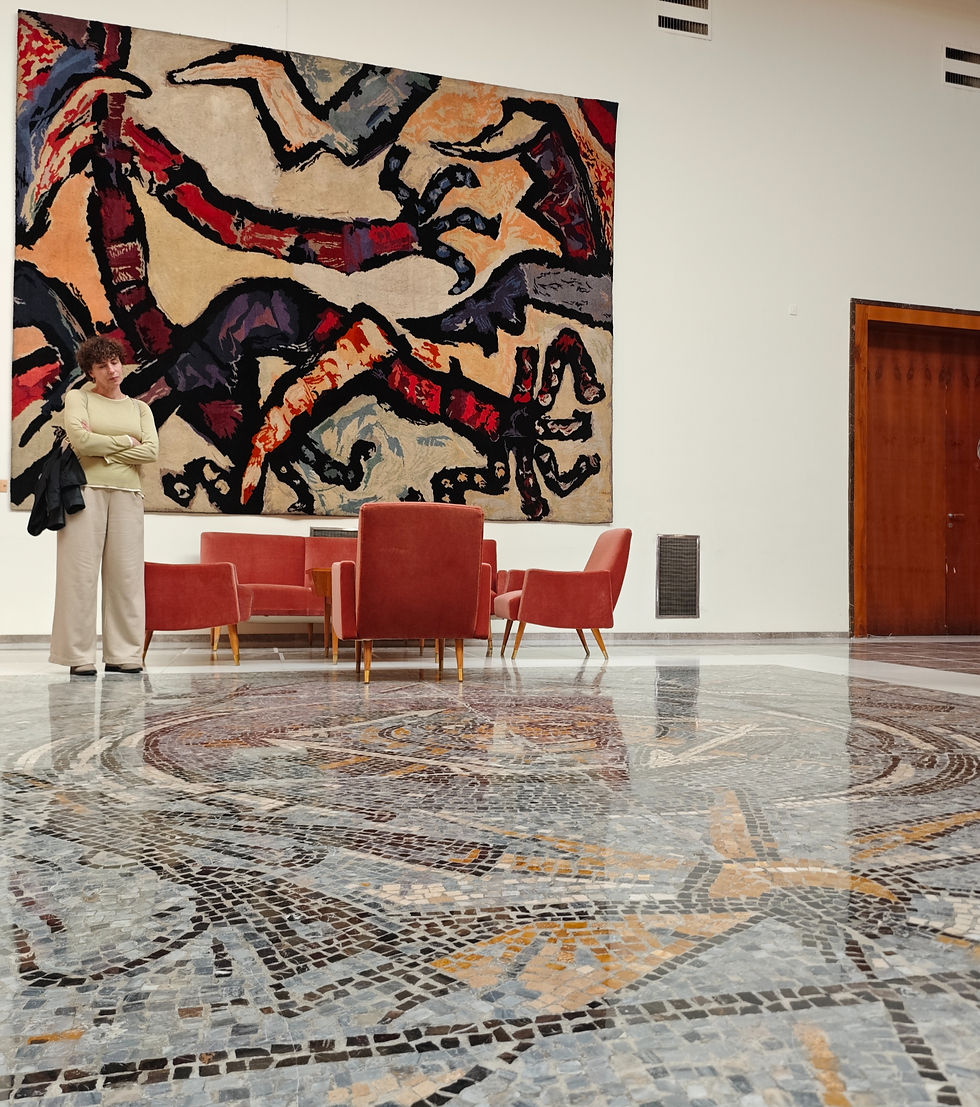
The hall also houses one of the Palace's most important artworks: Ceremonial – Along the Roads of the New Yugoslavia, a monumental wall composition by Lazar Vujaklija. Nearby are Petar Lubarda's famous The Road to Space and Mladen Srbinović’s large mosaic triptych. Together, these works embody the optimism and ambition of the young socialist state.

A Gallery of Yugoslav Modern Art
Throughout the building, visitors encounter frescoes, mosaics, sculptures, and monumental paintings by some of Yugoslavia’s leading twentieth-century artists, including Petar Lubarda, Milo Milunović, Đorđe Andrejević Kun, Sava Sandić, and Slovenian painter Mario Pregelj. The scale and quality of these works rival those of major museums, yet they remain hidden from public view behind the Palace’s official façade.
Luxury in Every Detail
No expense was spared during construction. The central halls are finished in marble, offices feature elegant parquet floors, staircases are clad in granite, and doors are crafted from polished walnut or oak with bronze fittings. Every material reflects the prestige the building was intended to convey.
Tito's Office
Although Josip Broz Tito had a private office in the Palace, he rarely used it. Interestingly, later presidents of Yugoslavia also avoided occupying the so-called „Tito's office“, preferring instead the former office of Aleksandar Ranković.
Why This Visit Was So Special
The Palace of Serbia continues to serve as an active government building, hosting state ceremonies and international meetings. For this reason, it is normally open to the public only once a year during the European Heritage Days.
Thanks to the cooperation between the Slovo Language Center and the cultural department of the Palace of Serbia, our students were given the rare opportunity to explore this extraordinary building outside the regular public program.
We believe that learning a language goes far beyond the classroom. It means discovering the country’s history, culture, and society firsthand.
And where better to experience all three than in a place where Yugoslavia still speaks through its architecture, its art, and its history?


Comments