
The History of the Serbian Language
Updated: Dec 5, 2025
Did you know that all Slavic languages originate from a single ancestral language called Proto-Slavic?
Many Proto-Slavic words are still alive today in Serbian, including čovek (man), dete (child), kost (bone), koža (skin), mati (mother), muž (husband), greh (sin), dosada (boredom), konj (horse), lisica (fox), medved (bear), and many others. It was based on this language that Cyril and Methodius created the first Slavic script — Glagolitic. The first Slavic literary language, Old Church Slavonic, grew out of this foundation.

The Beginning of the Serbian Language (12th century)
Linguists can speak of a distinct Serbian language only from the 12th century onward, when specific Serbian grammatical features began to separate from the common Slavic linguistic continuum.
One word that comes from this period is “dijak,” which meant “scribe.” Today, a related word survives as “đak,” meaning “pupil.”One of the oldest preserved manuscripts written in this language is the Miroslav Gospel. The language of this period is known as Serbo-Slavonic — the Serbian recension of Old Church Slavonic.

The Serbian Cyrillic Tradition
Dušan’s Code, the first original Serbian legal code, was also written in this Serbo-Slavonic period, using the Cyrillic script.
Serbian Cyrillic has its own distinctive features. Unique letters such as ћ and ђ exist only in Serbian. They developed from an earlier letter called “đerv,” documented as early as the 12th century in the Charter of Ban Kulin. This makes the Serbian Cyrillic alphabet one of the most characteristic markers of Serbian linguistic identity.

Ottoman Influence and the Arrival of Turkisms
After the Ottoman Empire conquered Serbian lands, the development of language and culture slowed significantly. During this period, many Turkish loanwords entered Serbian — some of which remain in daily use:
jastuk (pillow)
jorgan (duvet)
čarape (socks)
kafa (coffee)
ćufta (meatball)
duvan (tobacco)
18th Century: The Era of the Russo-Slavonic Language
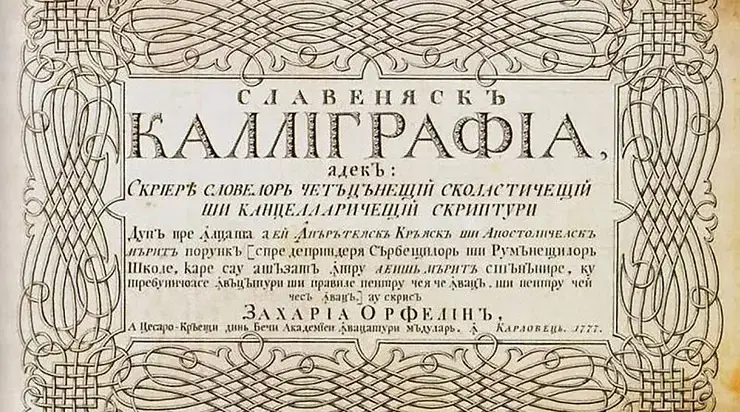
In the 18th century, a new literary language appeared among Serbian speakers — Russo-Slavonic. Responding to requests from Serbian scholars, two teachers from Russia brought books written in Russian and Russo-Slavonic to support cultural and linguistic revival.
Words used during this period included okončenije (ending), sklonenije (declension), vkus (taste), pečatnja (printing), prizrenije (care), and others.From this mixture emerged Slaveno-Serbian, a blended language combining elements of contemporary and older Russian and Serbian.
A Split Between Spoken and Literary Serbian (12th–18th century)
For centuries, spoken Serbian and literary Serbian were dramatically different. Only in the early 19th century did the idea arise that the vernacular — the everyday spoken language — could and should become the basis of literature.This linguistic revolution is associated with Vuk Stefanović Karadžić, one of Serbia’s greatest language reformers, and with several predecessors who paved the way.
Early Reformers: Sava Mrkalj
Sava Mrkalj was an important precursor to Vuk. He proposed an alphabet of 29 letters — almost identical to the one used today.Some letters (ј, ћ, ђ, љ, њ, џ) were written differently at that time; Vuk would later standardize them.
The Reforms of Vuk Karadžić
Vuk Karadžić is remembered for:
collecting folk tales, songs, and proverbs
reforming grammar and orthography
shaping the modern Serbian alphabet
creating the famous Serbian Dictionary
The dictionary appears in two editions (1818 and 1852).In it, Vuk documented words from the spoken language and adapted older Slavic forms to Serbian pronunciation, such as:
prvorodstvo (instead of prvorodstvije)
rođenje (instead of roždenije)
He also included Turkisms common in everyday speech:amajlija (amulet), badava (for nothing), aždaha (dragon), zanat (craft).
Because of his work, Vuk was heavily criticized, and for a time even banned from entering Serbia by royal decree.His ideas were officially accepted in Serbia in 1868, forming the foundation of the modern language.

Modern Serbian: “Write as You Speak”
Today, the literary and spoken forms of Serbian are almost identical, with only minor differences in vocabulary.
A core principle of the language — and one of its most recognizable features — is:
“Write as you speak, speak as you write.”
Each sound corresponds to exactly one letter.This clarity is the result of centuries of work by teachers, linguists, writers, and reformers — from medieval scholars to Vuk Karadžić and beyond.
Author:
This text was prepared by the teaching team of the Serbian Language Center Slȍvo.
Learn more about us and our programs: centarslovo.rs.


Comments